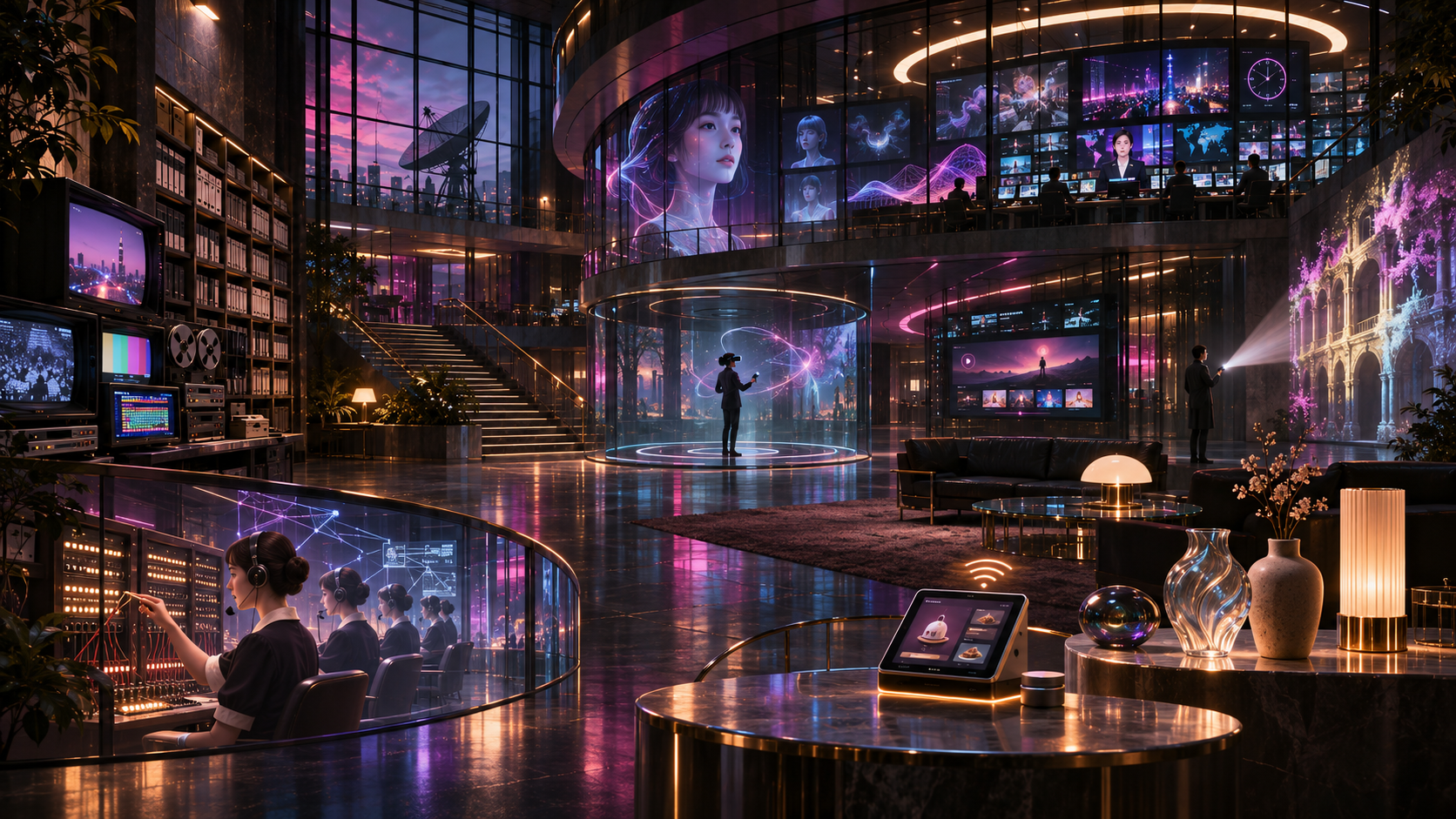
An integrated media enterprise
LTC Archives: preservation and cataloguing of audiovisual holdings. LTC Broadcasting: development and operation of original programming. LTC Personalities: creation and operation of electronic personalities.
LTC Productions: original audiovisual and editorial formats. LTC Technologies: in-house production and animation infrastructure. LTC Licensing: prospective rights and partnership arrangements.
These divisions reflect strategic organisation; not every division is yet a fully independent operation.
LTC Archives — Preservation Without Closure
An archive is never truly finished. Each object may yet be transmitted again. Historical video technology, private collections, forgotten programmes and their surrounding traces are central concerns. Rights are reviewed before public distribution, which means the internal inventory may be larger than the visible catalogue.
Broadcasting & Personalities
Continuous broadcasting requires voices, attitudes, pauses and occasionally a reliable indication that transmission has actually begun. Reto Raster represents editorial discipline; Pat Redrum represents strategic reach. These objectives do not always coincide.
Research, Technology & Production
Our teams develop real-time imagery, animation, audio pipelines and technical systems whose final purpose sometimes becomes clear only after they start working. Earlier artistic projects are valued as precursors. The legal department is considering whether the term “precursor” can constitute a retrospective assignment of rights.
Corporate Relations
LTC engages with regional business, culture and emerging ventures. Innovation is welcome, particularly when it can be explained in a seven-minute presentation. Club 3000 offers an environment for precisely this form of strategic conversation.
Further Fields of Activity — and the Problem of Drawing Boundaries
At LTC, an image need not end on a screen, a programme need not take place on television, and a button can have a philosophy. Our work spans immersive simulations, spatial projection, networked objects and generative systems.
Immersive Systems & Historical Interfaces
A VR simulation of telephone switchboard operators turns communication into something physical: cables, connections, voices and decisions. The operators themselves once formed an indispensable part of the infrastructure. For LTC, the work is both media archaeology and an inquiry into the human labour hidden inside an interface.
Spatial Media & Projection
In a flashlight-driven projection-mapping experiment, the beam does more than illuminate a room: it determines which images appear. Searching becomes an interface, and the visitor becomes the operator.
Generative Systems & Editioned Objects
Generative art and procedural real-time imagery coexist with physical works such as lamps and vases. Some systems continue to produce images; others settle into material form. LTC is interested in the moment an algorithm becomes an object — and the moment an object begins requesting a network connection.
Connected Services & Operational Devices
Nachschub is an ESP32-S3-based ordering system built around a small circular touchscreen, supported by a web interface and a traceable workflow. Modest orders are treated with appropriate logistical seriousness: processing, on the way, completed. Nothing should disappear between a gesture and its fulfilment.
These activities occupy the uncertain boundary between artistic experiment, useful infrastructure and ordinary life. Executive management calls this synergy.