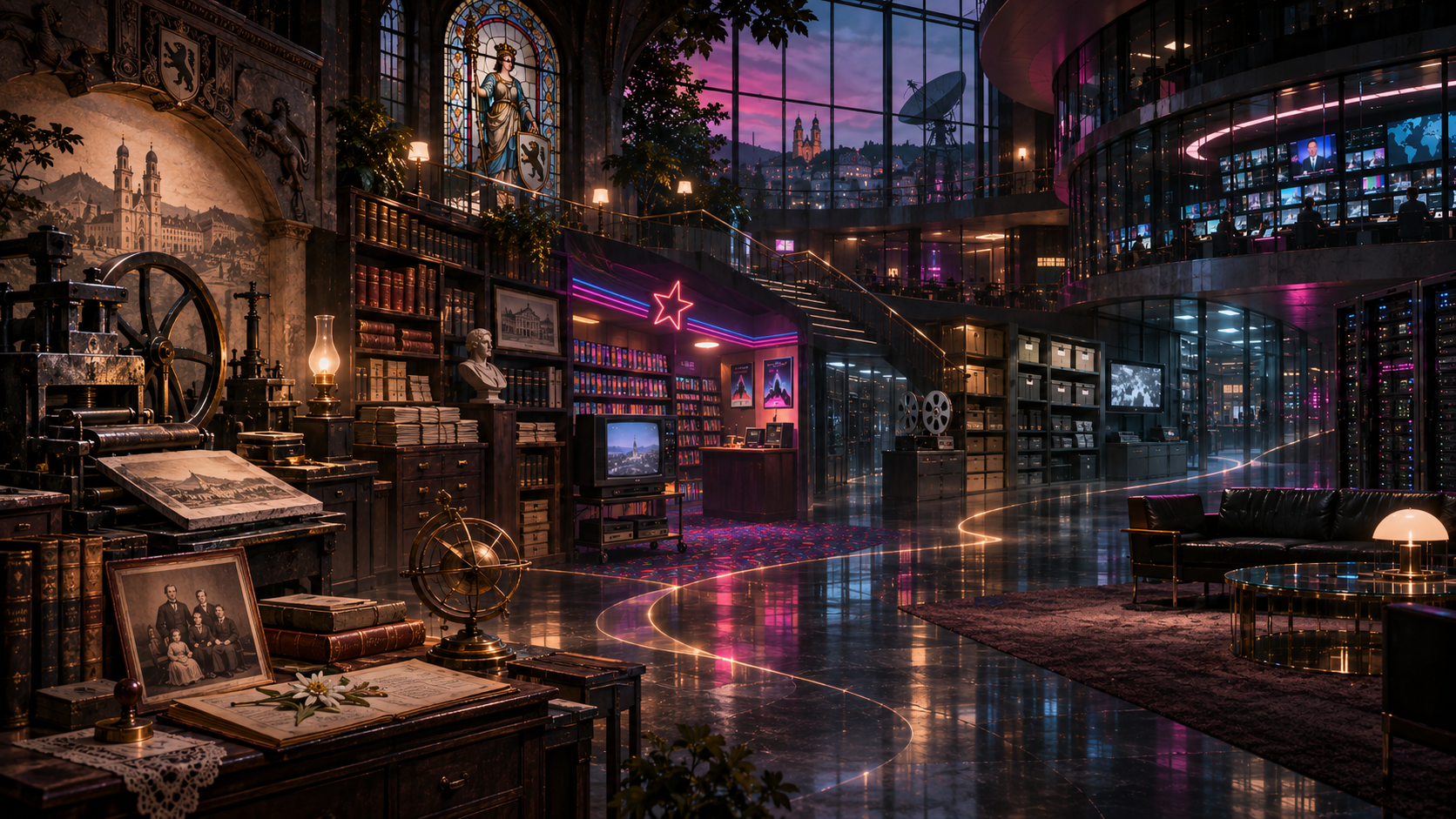
From printing plate to broadcast signal
LTC Corporation views media history not as a succession of obsolete technologies but as one continuous transmission, occasionally interrupted. The trail begins in St. Gallen, long before anyone had invented a corporate name for it.
1882 — Paper
Lithographer Gustav Baumgardt established a workshop on Wassergasse in 1882. A 1903 St. Gallen directory records “Baumgardt, G., Lithographie, Wassergasse 23”. Printing remained part of the family's story across generations. Images were copied, circulated and retained. The Corporation now calls this its analogue prehistory, a term conspicuously absent from the original accounts.
Schwalbenverlag — Images in transit
The printing tradition continued through Schwalbenverlag, known in the family story for hand-coloured Swiss picture postcards, town views, architecture and church imagery. The images travelled beyond their place of origin. LTC's internal histories classify this as an early international distribution operation.
1982 — STAR
In the early 1980s the next generation opened the independent STAR video rental shop in St. Gallen. Fluorescent lighting, carpet, a perforated suspended metal ceiling and rows of videotapes replaced the printing workshop's materials. Its slightly asymmetrical red star — almost a comet — was designed by graphic artist and family friend Walther Büsser, also credited in the family account with the Schwalbenverlag emblem. Family recollections place him in Masonic circles; the Corporation's archive notes this detail as awaiting further documentation. Some signs survive their original businesses.
LostTapeCult — After the rental counter
STAR operated for only a few years, but the idea of distributing, borrowing and rediscovering images outlived it. Decades later, LostTapeCult approached neglected audiovisual material with an archivist's curiosity and an operator's fascination with the machinery of transmission.
An unexpected personnel file
Reto Raster was not recruited in the usual way. The preferred account attributes his emergence to experiments combining archival images with temperamental electronic systems. No conclusive record identifies the precise moment at which an apparatus became a colleague. Reto finds the distinction administratively unhelpful.
The agreement
When the archive's future became financially uncertain, Pat Redrum was deliberately developed to supply business leadership. His licensing arrangement with Continuity Systems secured a future for the operation — while leaving some ambiguity over the scope of the licensed assets. Archive footage, reconstruction techniques and the properties of electronic personalities are not consistently separated in the surviving contractual descriptions. Pat calls this “future-proof drafting”.
The Corporation
LTC now brings archives, broadcasting, original productions and electronic personalities under one identity. Whether the line from a lithographic workshop to a media corporation is historical, operational or principally contractual depends on which department answers. Archives will provide clarification once the relevant records have been located.
Club 3000 — Networking beyond the millennium
St. Gallen has a long tradition of professional and social networks. LTC Corporation honours that tradition by adding another thousand. Club 3000 brings together established business circles, aspiring founders and those who have yet to decide what their company will actually do. Where one generation exchanged business cards, the next exchanges pitch decks. The conversations are reassuringly similar.
Membership is selective; the selection process is confidential. The CEO describes the organisation as a forum for visionary continuity. No relationship with any similarly named association is implied or acknowledged.